

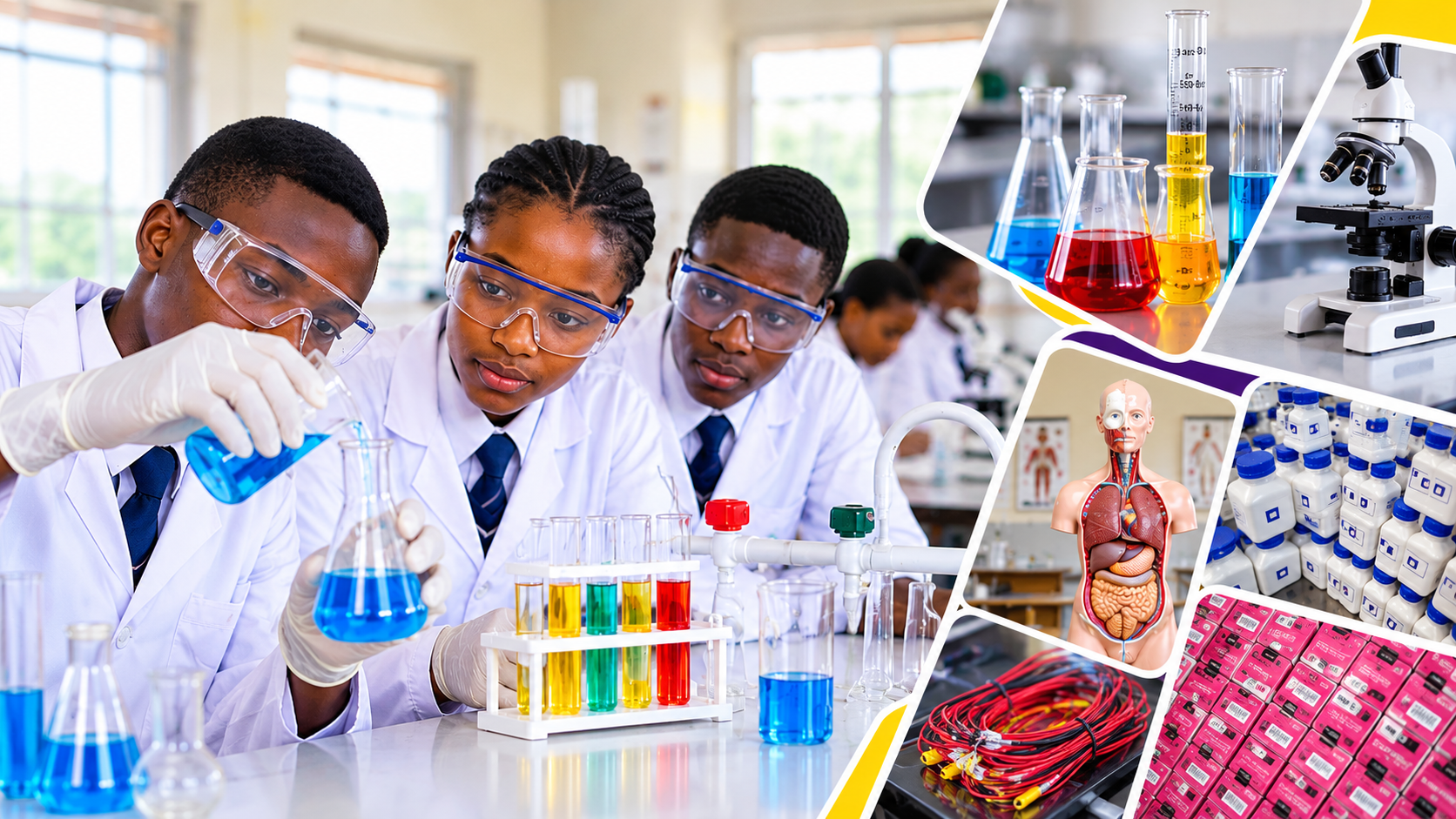
Science helps learners understand the world around them. From studying the human body to exploring chemical reactions and electrical circuits, science gives students the knowledge and skills they need to solve real-life problems.
However, learning science becomes more effective when students have opportunities to conduct experiments and interact with scientific equipment.
A well-equipped science laboratory provides this opportunity.
1. Making Science More Practical
Science is not only about reading textbooks and memorising facts. It also involves observing, experimenting, measuring, and drawing conclusions.
For example, students studying chemistry can use laboratory equipment to investigate acids, bases, and chemical reactions. Biology students can examine specimens and study the structures of living organisms. Physics students can use measuring instruments to investigate electricity, motion, and other scientific principles.
These practical experiences help learners connect classroom theory with real-life situations.
2. Improving Students’ Understanding
Some scientific concepts can be difficult to understand when they are explained only through words or diagrams.
Laboratory equipment and learning materials help teachers make these concepts clearer.
Using beakers, test tubes, measuring instruments, microscopes, models, and biological specimens, teachers can demonstrate scientific principles in ways that learners can see and explore.
Practical activities also encourage students to ask questions, investigate problems, and develop their own understanding of scientific ideas.
3. Developing Critical Thinking and Problem-Solving Skills
Laboratory experiments encourage learners to think beyond memorising information.
During practical activities, students may be required to identify a problem, formulate a hypothesis, select suitable equipment, collect observations, and interpret results.
These activities help develop critical thinking, accuracy, teamwork, and problem-solving skills.
Such abilities are valuable not only in science subjects but also in everyday life and future careers.
4. Preparing Learners for Future Careers
A strong foundation in practical science can prepare students for further education and careers in medicine, engineering, agriculture, environmental science, laboratory technology, and scientific research.
Early exposure to laboratory equipment helps learners become familiar with scientific procedures and develop confidence when conducting experiments.
Schools that provide practical learning opportunities can therefore help learners explore their interests and make informed decisions about their future careers.
5. Choosing the Right Laboratory Equipment
Schools need suitable laboratory equipment to support effective science teaching.
Some essential categories include:
- Chemistry equipment: Beakers, test tubes, burettes, conical flasks, measuring cylinders, and other laboratory apparatus.
- Biology resources: Biological specimens, human anatomy charts, microscopes, and related learning materials.
- Physics equipment: Ammeters, voltmeters, measuring instruments, electrical components, and experiment kits.
- Laboratory reagents: Appropriate chemicals and prepared solutions required for approved practical activities.
- Science learning materials: Textbooks, models, charts, and other resources that support classroom instruction.
The choice of equipment should reflect the subjects taught, the curriculum requirements, the available laboratory space, and the school’s budget.
Schools should also ensure that laboratory facilities support safe storage, proper handling of chemicals, and responsible disposal of laboratory waste.
How Benzene Science Hub Ltd Supports Science Education
At Benzene Science Hub Ltd, we understand the importance of practical learning in science education.
We supply laboratory equipment, reagents, chemicals, biological specimens, science learning materials, and science textbooks to schools, universities, research institutions, and individual educators.
Our goal is to help teachers and learners access the resources they need for effective teaching, practical learning, and scientific discovery.
We believe that every learner deserves an opportunity to experience science beyond the classroom textbook.
Conclusion
A well-equipped science laboratory is an important investment in the future of learners.
By providing suitable equipment, learning materials, and opportunities for practical activities, schools can make science more engaging and help students develop essential scientific skills.
Are you looking for laboratory equipment or science learning materials for your school?
Contact Benzene Science Hub Ltd to discuss your requirements.
Call us: 0393002241 / 0756816822 / 0703250840 / 0773501958
Visit us: Makerere-Kavule, between NUP Offices and Tosha Fuel Station.
Benzene Science Hub Ltd — Accuracy is Priority.